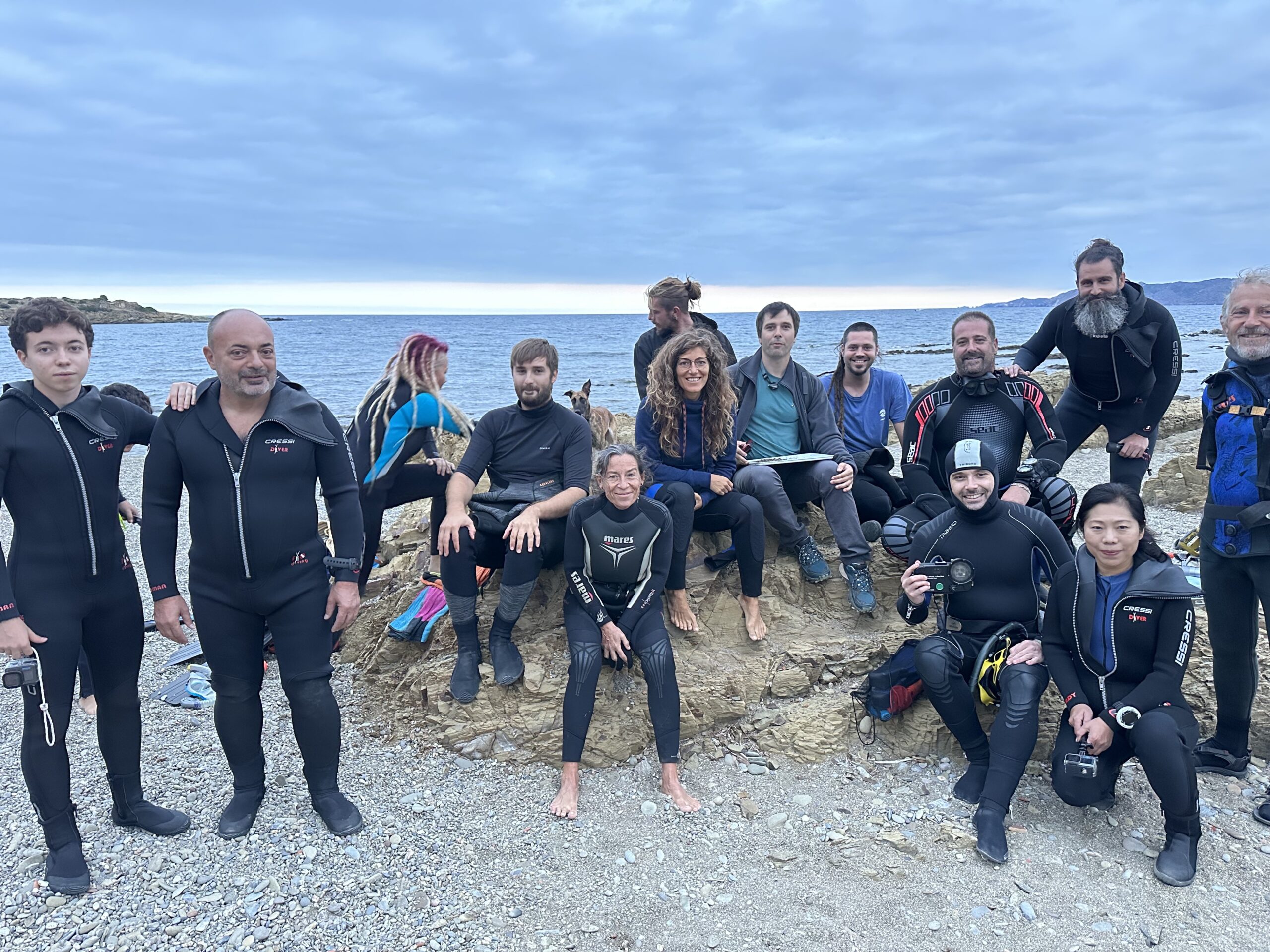
The bioblitz brought together local residents, visitors, and diving enthusiasts to explore, observe, and document marine species inhabiting this protected area. Through these collaborative field sessions, participants contributed to generating valuable open-access data that will help enhance the scientific understanding and conservation management of the site.

What is a bioblitz?
A bioblitz is a citizen science activity that brings people together with a common goal: to document as many species as possible in a given location within a short period of time. The collective effort of participants creates an instant snapshot of biodiversity, a “photograph” of the state of an ecosystem at a particular moment. The data obtained, shared on open platforms such as iNaturalist, is highly valuable for both research and management of natural areas.
In the case of L’Albera, two complementary sessions were held to capture both day and night biodiversity. The daytime session, on 20th September, focused on shallow and deeper areas, where participants recorded algae, fishes and invertebrates associated with Posidonia oceanica meadows and rocky seabeds and reefs. A week later, the night-time session, on 27th September, allowed participants to observe the same habitats under a different light. Equipped with diving torches, they documented species that are more active or easier to spot at night, such as the Mediterranean cardinalfish (Apogon imberbis), the black scorpionfish (Scorpaena porcus), the European conger (Conger conger), or invertebrates like the green spoonworm (Bonellia viridis) and the white-spotted octopus (Callistoctopus macropus).
In total, 26 participants took part across both sessions, with snorkelling used to explore shallower areas and scuba diving to access deeper zones, allowing the group to efficiently cover the entire survey area. This approach highlighted the ecological richness and complexity of L’Albera’s marine environment, while enabling participants to document a wide range of species across different habitats.

Throughout both sessions, participants recorded a remarkable amount of data: 398 observations during the daytime, identifying 102 species, and 489 observations at night, with 124 marine species recorded. Recorded species richness was similar in both sessions, with the highest diversity found among fishes and mollusks, which together accounted for nearly half of all identifications. Algae, sponges and crustaceans also contributed significantly to the overall diversity registered. The remaining species belonged to cnidarians, bryozoans, tunicates and seagrasses, the latter represented solely by Posidonia oceanica.
Together, these findings illustrate the potential of citizen science to complement research and management efforts in marine protected areas (MPAs). By engaging citizens directly in observation and data collection, initiatives like this bioblitz help advance BLUE CONNECT’s broader objectives: enhancing knowledge of marine ecosystems, strengthening community involvement, and promoting the sustainable management of MPAs and coastal and marine habitats across Europe.