
The workshop ran back-to-back with the Black Sea Common Maritime Agenda Annual Stakeholder Conference 2026 and the MEDIGREEN “Beyond Borders” workshop, putting BLUE CONNECT’s work right at the centre of wider discussions on marine conservation and maritime cooperation in the region.
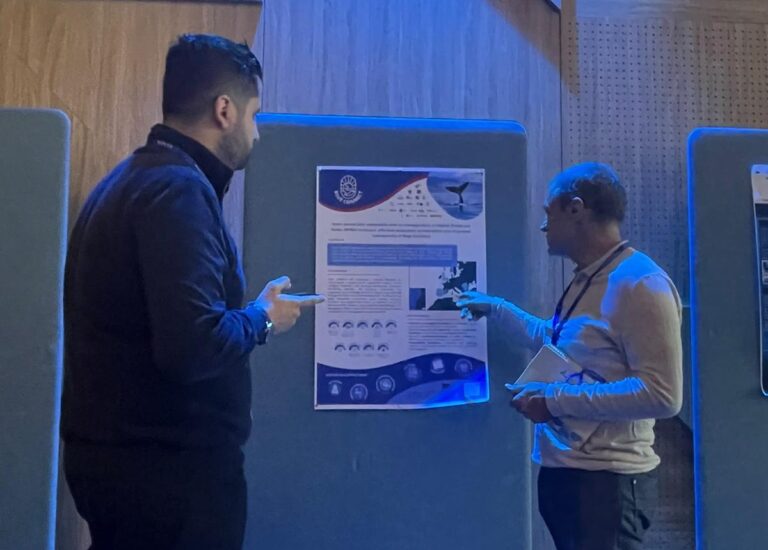
BLUE CONNECT was also represented during the Stakeholder Conference itself, where Hristo Stanchev from CCMS presented the project poster and shared its work and emerging results with the wider Black Sea community.
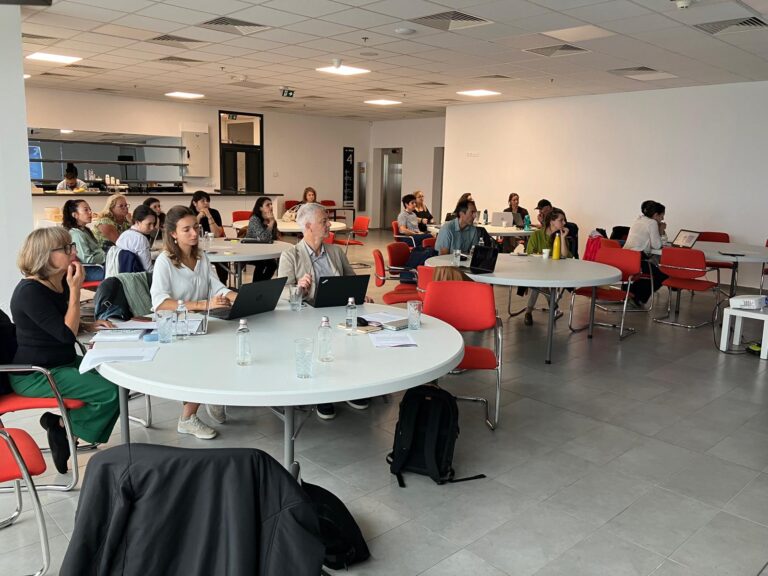
Against this broader regional backdrop, the workshop provided a space to exchange experiences between the BLUE CONNECT Demonstration Sites in Burgas Bay and the Romanian Central Coast, discuss progress on the ground and explore opportunities for stronger cooperation across borders.
From evidence to conservation action
The discussions demonstrated the substantial progress already being made in both Demo Sites.
In Burgas Bay, work on seagrass distribution, condition and connectivity is generating new evidence to support conservation planning. More than 95% of the 917 hectares of mapped seagrass meadows are located within Burgas Bay, confirming the area as an important national seagrass hotspot. Genetic and structural connectivity analyses are helping identify differences in the resilience of Zostera populations, as well as key habitat patches, ecological links and potential corridors that could be prioritised for conservation and restoration.
On the Romanian Central Coast, spatial assessments are bringing together information on human pressures and ecosystem sensitivity to identify cumulative-impact hotspots and priority areas for action. High-resolution monitoring, autonomous surface vehicles, seabed mapping and satellite data are also being combined to strengthen understanding of valuable coastal habitats and support more responsive management. The next steps include refining species-distribution models, assessing habitat vulnerability and connectivity, and identifying areas where stronger conservation measures could be appropriate.
Connecting Demo Sites – and people
A central message from Burgas was that ecological connectivity needs to be matched by stronger cooperation between institutions, stakeholders and countries.
Participants explored common measures for better conservation of seagrasses in Bulgaria and Romania and discussed how BLUE CONNECT’s common co-management methodology can be adapted to the realities of individual Demo Sites. The methodology provides a shared framework for stakeholder engagement, governance assessment, knowledge integration, co-design and adaptive management, while leaving space for locally tailored approaches.
The discussions also pointed clearly towards the next phase of cooperation. Participants identified practical joint actions across sectors and borders as the leading priority for the coming years, alongside stronger stakeholder participation and institutional support for co-management.
The Burgas workshop therefore marked another step in moving BLUE CONNECT from shared knowledge towards connected conservation action. As work continues in the two Demo Sites, the evidence, tools and relationships being developed provide a promising basis for closer Bulgaria–Romania cooperation and, ultimately, more connected and effectively managed marine protected areas across the Black Sea.