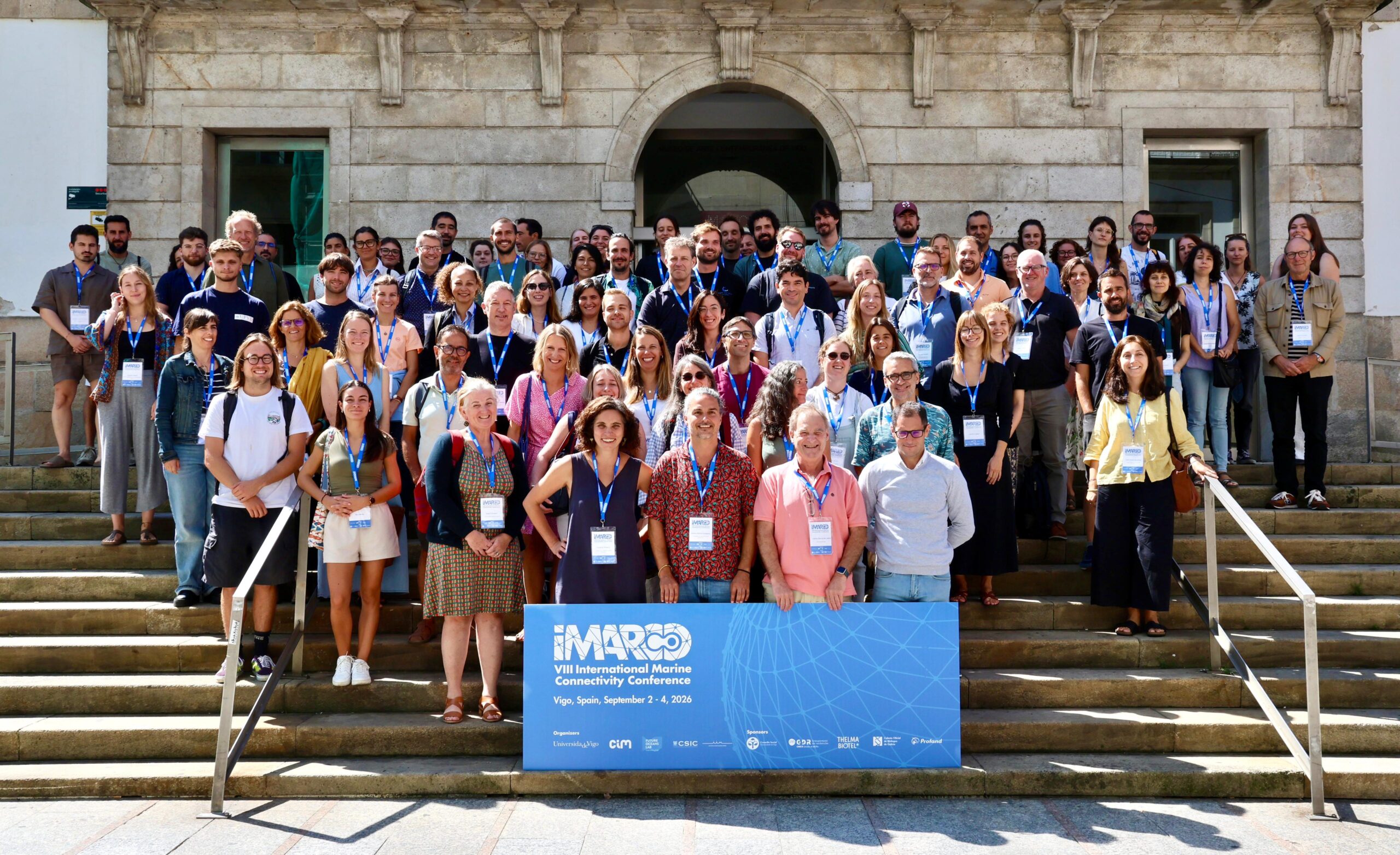
Bringing together around 100 researchers working on aquatic and marine connectivity, the conference provided an excellent opportunity to exchange knowledge, explore methodological advances and discuss how connectivity science can better support marine conservation and management.
The three-day conference covered a broad range of topics, from freshwater environments and land–sea interactions to marine connectivity, Marine Protected Areas (MPAs) and ecosystem management. Each day opened with a keynote lecture, followed by oral presentations, speed talks and poster sessions, creating a dynamic environment for scientific exchange.
Exploring different approaches to connectivity
One of the main takeaways from the conference was the diversity of approaches currently being used to investigate ecological connectivity.
Three major methodological approaches emerged repeatedly throughout the programme: otolith and other biological tracer analyses, fish tagging and telemetry, and Lagrangian particle-tracking simulations. These approaches are increasingly complemented by graph theory and network analysis, allowing researchers to move from identifying individual connections to understanding the structure and functioning of larger ecological networks.
The combination of connectivity modelling with network approaches is particularly relevant for conservation planning, as it can help identify key habitats, stepping stones and highly connected areas within marine protected area networks.
Connecting Marine Protected Areas across Macaronesia
A key contribution from the BLUE CONNECT community was the oral presentation “Towards better connected Marine Protected Areas in Macaronesia: a graph theory approach”, presented by Sofia Bosi, from CNR-ISMAR and Ca’ Foscari University of Venice. The work was developed through a recent research internship at the University of the Azores, which contributed directly to the scientific activities of the Macaronesia Demo Site. Following the internship, Sofia has continued to collaborate with the team, contributing to the objectives and ongoing work of the Macaronesia Demo Site Working Groups, particularly on marine connectivity and the development of approaches to strengthen the connectivity of Marine Protected Areas across the region.
The study assesses the structural connectivity of the recently implemented RAMPA – Rede de Áreas Marinhas Protegidas dos Açores using graph theory and Lagrangian particle-tracking simulations. In the analysis, Marine Protected Areas are represented as nodes in a network, while transit probabilities between MPAs form weighted, directed links.
The results highlight consistent seasonal patterns in the centrality of different MPAs and point to the importance of larger offshore protected areas for the overall connectivity of the network. The simulations also indicate that a substantial proportion of particles released within RAMPA subsequently leave the network, suggesting that the ecological influence of protected areas may extend beyond their formal boundaries.
Importantly, the study also explored connectivity beyond the Azores. A 2-year simulation for 2024-2025 identified structural connections between RAMPA and the other Macaronesian archipelagos, in particular Madeira, the Canary Islands and Cabo Verde. These findings support the concept of a broader Macaronesian marine corridor and reinforce the importance of considering connectivity across national and archipelagic boundaries when designing resilient conservation networks.
From scientific results to stronger connectivity-based conservation
Presenting the work at i-MarCo provided an opportunity to discuss the methodology with researchers specialising in marine connectivity and to receive valuable feedback on potential avenues for further development.
The discussions highlighted, among other aspects, the importance of exploring temporal variability in connectivity patterns, considering different years and environmental conditions, and further examining how the vertical dimension of the ocean and the biological characteristics of dispersing organisms can influence connectivity estimates.
These exchanges are particularly valuable for BLUE CONNECT, as the project seeks not only to improve our understanding of connectivity in the Macaronesian region, but also to translate scientific knowledge into recommendations that can support more connected, effective and resilient marine protected area networks.
Macaronesia as a connected ocean region
The strong presence of Macaronesian research throughout the conference was another important highlight. Alongside the BLUE CONNECT contribution, research presented at i-MarCo addressed connectivity in the Azores, Canary Islands and Cabo Verde, including work on highly migratory species and marine connectivity modelling.
Together, these contributions reinforce the scientific relevance of viewing Macaronesia not as a collection of isolated archipelagos, but as a connected ocean region where ecological processes cross administrative and national boundaries.
For BLUE CONNECT, participation in i-MarCo 2026 therefore represented more than an opportunity to present ongoing research. It provided a valuable space to connect with the wider international connectivity community, exchange methodological perspectives and strengthen the scientific foundations for future work on connectivity-based marine conservation and management across Macaronesia.
Follow the link below for the i-MarCo 2026 Book of Abstracts, including the BLUE CONNECT-related contribution.