This discussion is particularly timely in light of the EU’s restoration objectives, including the legally binding ambition to have restoration measures in place for at least 20% of EU sea areas by 2030, and to address all ecosystems in need of restoration by 2050.
Why this matters for BLUE CONNECT
BLUE CONNECT contributes to the debate by bringing on-the-ground experience from marine protection and restoration efforts across Europe—highlighting both what is feasible and what remains challenging when moving from ecological ambition to real implementation.
The BLUE CONNECT project aims to safeguard and restore marine habitats by addressing gaps in EU and global legislation and by engaging MPA managers, authorities, industries, and local communities across 12 demonstration sites in four EU sea basins. Within this broader effort, two demonstration sites provide particularly relevant insights for emerging nature credit schemes: one focused on oyster reef restoration and one on seagrass restoration.
BLUE CONNECT session in the programme
BLUE CONNECT will present during the workshop’s “Pilots and demonstrations” segment:
“Nature restoration programs in Belgium and Spain – Blue Connect project”
Speakers: Mieke Eggermont (U.Gent) and Andreu Dalmau (SUBMON)
In this contribution, BLUE CONNECT will share practical lessons from two restoration contexts:
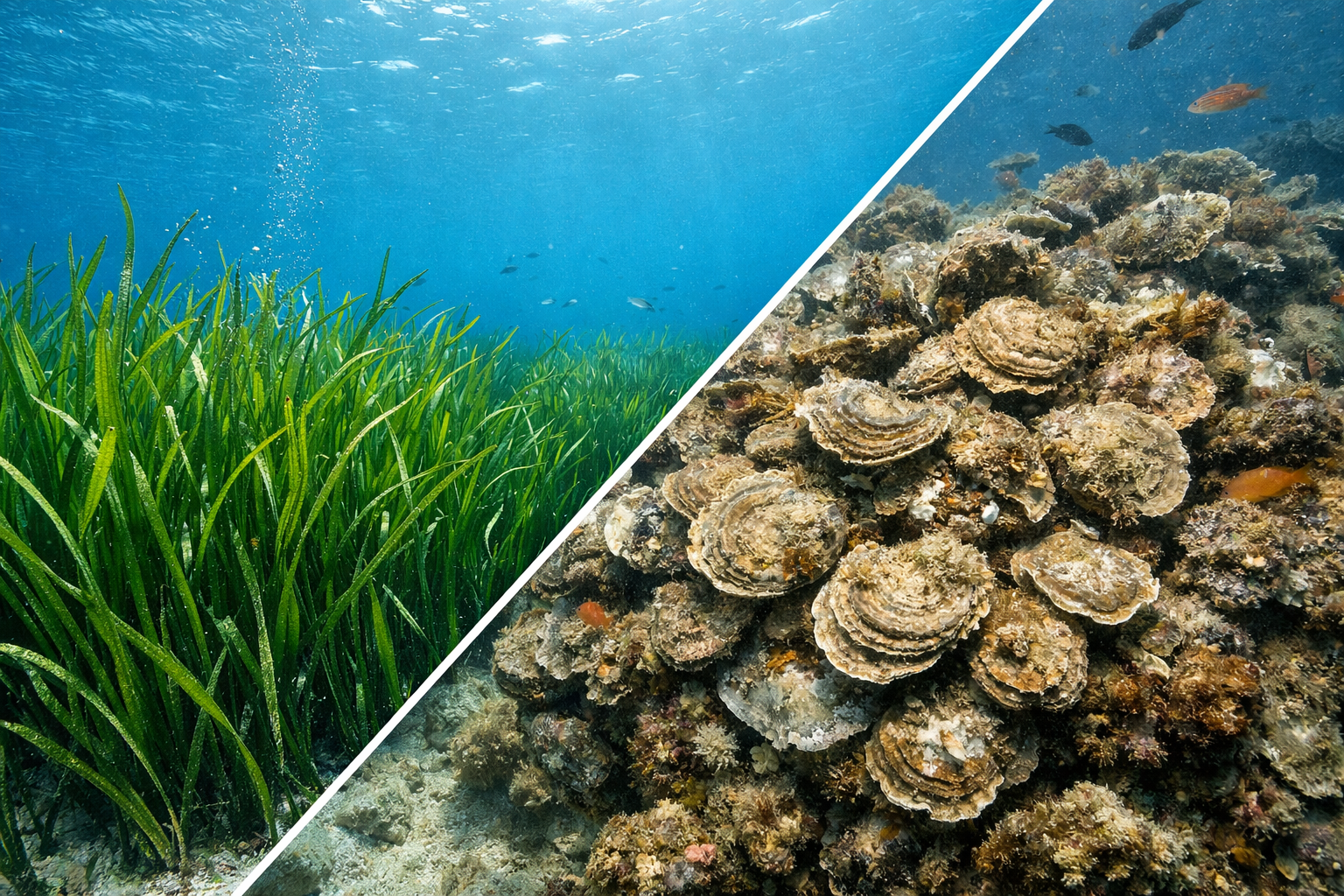
- Belgian North Sea (Vlaamse Banken MPA): European flat oyster reef restoration (Ostrea edulis).
The site is implementing active oyster reef restoration as part of the National Restoration Plan. With natural spat and suitable substrate in short supply, spat-on-stone will be deployed to initiate reef development. These structures provide a stable basis for reef formation, supporting settlement and expansion over successive generations. Restoration is paired with systematic monitoring, integrating baseline data and assessing ecological outcomes in collaboration with management authorities. - L’Albera, Catalonia (Spain): Neptune grass restoration (Posidonia oceanica).
Restoration focuses on a slow-growing Mediterranean seagrass species with crucial ecological importance. Only naturally uprooted shoots are used—collected with local community support—and replanted using bamboo and metal tongs in experimental quadrants. Given the species’ generally low survival rates under active restoration, long-term monitoring is essential, and conservation priorities must also focus on reducing pressures on existing meadows. The work therefore combines a low-impact restoration effort with awareness-raising on seagrass decline and its drivers.
Together, these cases illustrate both the promise and the complexity of marine restoration in Europe—especially when considering how restoration outcomes may be quantified, verified, and potentially recognised within future nature credit approaches.
Practical information
- Event: Workshop | Nature credits in the EU’s coastal and marine ecosystems
- Date & time: Friday, 30 January 2026, 09:00–12:15 CET (online)
If you are working on coastal and marine restoration, marine protected areas, investment frameworks, or monitoring and verification approaches, this workshop is a strong opportunity to follow the EU conversation on how nature credits could be designed to be credible, practical, and fit-for-purpose for marine ecosystems.
For more information see: