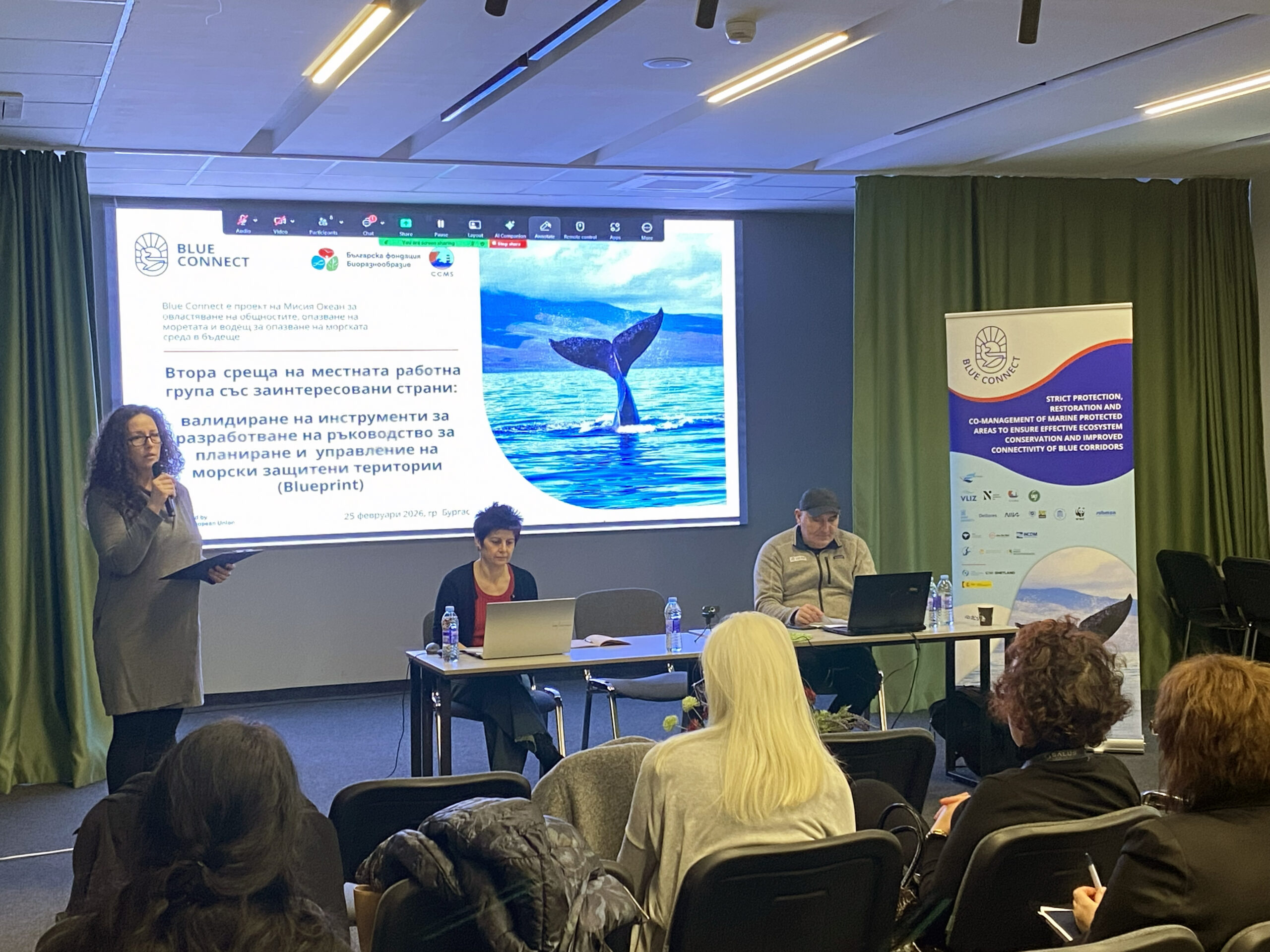
The workshop focused on building a shared understanding of the BLUE CONNECT Operational Framework and validating key analytical tools and first results for Burgas Bay Demo Site. In the discussions, the participants supported the ecological prioritisation process and the structural connectivity analysis of seagrass Zostera marina. A clear convergence of views emerged regarding priority pressures. Dredging for shellfish harvesting and fisheries-related bottom disturbance were identified as major cumulative impacts on seagrasses requiring stronger monitoring and enforcement. Diffuse pollution, including from wastewater treatment plants, eutrophication and sediment inputs—particularly following extreme flood events—were also confirmed as significant stressors that require stronger integration into cumulative pressure analysis. Shipping traffic and anchoring were further highlighted as pressures affecting connectivity.
The assessment of cumulative pressures on marine mammals, seagrasses and reef habitats triggered substantive discussion on data availability, governance gaps and enforcement challenges.
The draft methodology for adjustment of the screened co-management and co-ownership schemes was presented as a pathway toward improved coordination and shared responsibility. Considering the evolving legal framework, participants agreed that further refinement and institutional dialogue will be necessary to ensure its practical uptake. The representative of Ministry of Environment and Water (MPA authority) share information for a new approach (in the context to the proposed co-management scheme), in the newly adopted “REGULATION on the conditions and procedure for developing and approving territorial plans for the management of protected areas”. It provides the establishment of a committee of stakeholders, which includes representatives of territorial and local authorities, scientific organizations and higher education institutions, regional structures or regional representatives of industry, trade unions, employers and other sectoral organizations, owners and users of sites in marine spaces, resource users, non-governmental organizations. It is envisaged that the stakeholder committee will participate in the entire process of developing marine protected areas (MPAs); in discussing and providing the information necessary for the development of the MPAs, as well as consulting on the progress of the MPA development process.
Тhe workshop represents an important step toward more coherent, science-based and participatory marine governance in Burgas Bay, contributing to improved planning and management of MPAs.