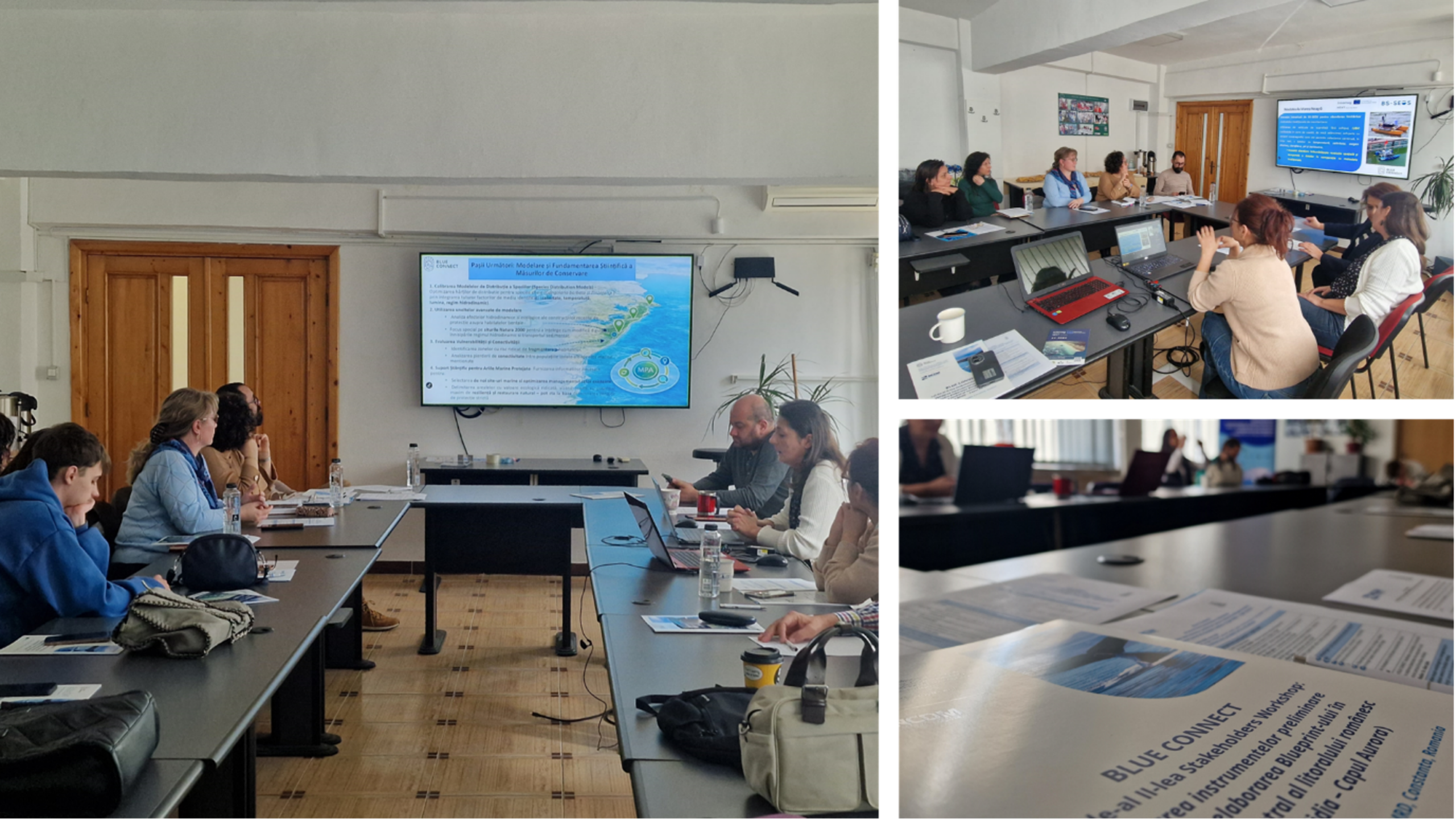
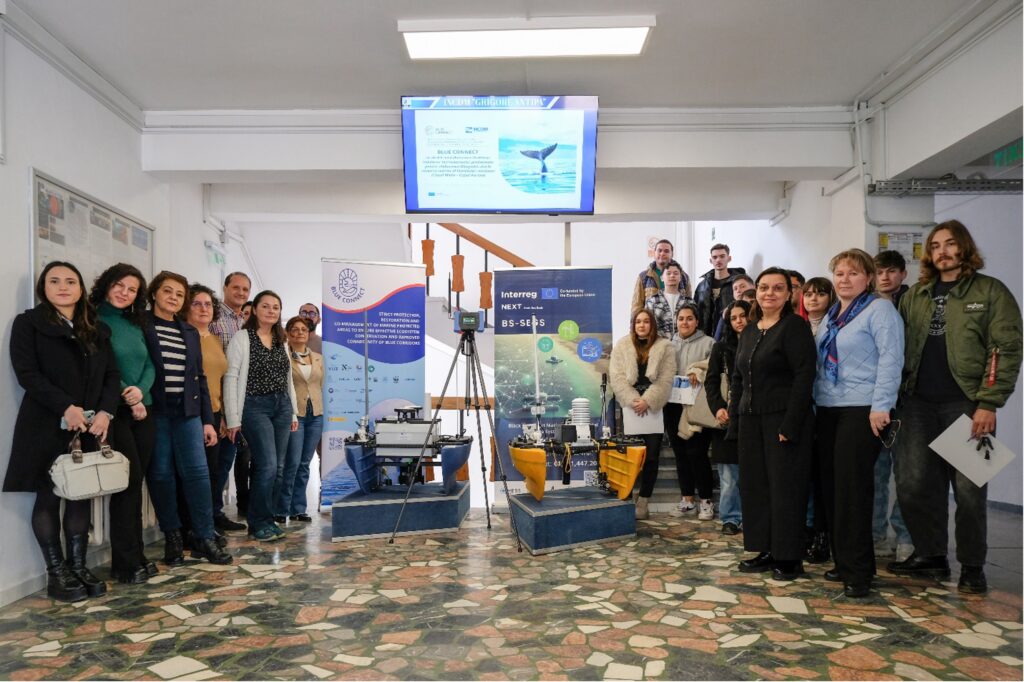
The stakeholder meeting was held on February 24, bringing together representatives of public authorities, experts, members of the business sector, and local communities engaged in a constructive dialogue on the protection and restoration of marine ecosystems in the Black Sea.
The meeting aimed to validate the preliminary tools, methodologies, and scientific results developed within the BLUE CONNECT project for the central sector of the Romanian littoral Demo Site (Midia Cape – Aurora Cape), while also fostering dialogue with stakeholders on validating the co-management and co-ownership methodology. By actively involving institutional representatives and experts, the project continues to ensure that its outputs are relevant, feasible and aligned with local realities.
Discussions focused on the prioritization of phytobenthic species (Gongolaria barbata and Zostera spp.) based on their ecological value and on analyzing their spatial dynamics along the Romanian Black Sea coast. These insights are essential for identifying ecologically significant areas and supporting evidence-based decision-making.
A significant highlight of the meeting was the presentation of cumulative effect mapping, a sophisticated tool designed to visualize how various human activities overlap and impact vital marine ecosystems. By identifying ecological “hot-spots” and priority risk zones, these maps provide a clear picture of where our coastal environment is under the most pressure.
A key focus of the meeting was the presentation of advanced modeling tools that aim to evaluate how coastal protection structures—such as breakwaters, groynes, and beach nourishment—impact the benthic habitats. These tools are particularly vital for Natura 2000 sites, as they help us understand how recent changes along the shoreline and on the seafloor affect the vulnerability and connectivity of marine habitats.
The project is introducing Unmanned Surface Vehicles equipped with advanced sensors and imaging systems to monitor vital habitats like Gongolari barbata and Zostera spp. Stakeholders strongly support integrating these “sea drones” into national programs, as they offer higher-resolution data and more consistent results at a lower cost. The meeting also explored a new methodology for co-management and co-ownership of Marine Protected Areas, aiming to involve local fishers, tourism operators, and NGOs in the decision-making process. While participants noted that practical application in Romania currently faces challenges due to institutional gaps, they agreed that strengthening collaboration between scientific bodies and local actors is the essential first step toward more effective and inclusive marine management.